

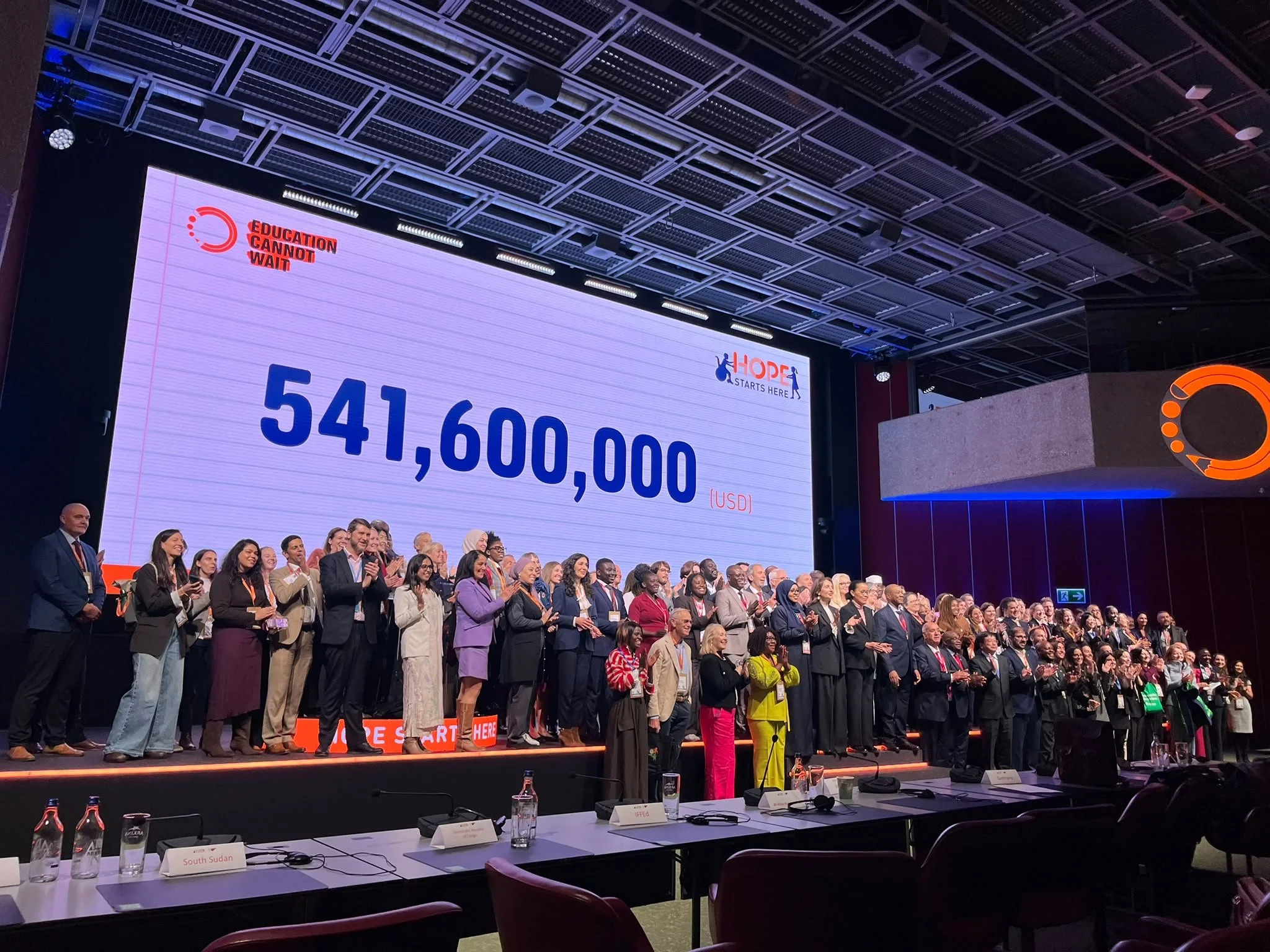
Attendees of the high-level replenishment event for Education Cannot Wait celebrated the total pledge of $541.1m USD to support education in emergencies. (Image: IPNEd)
The high-level replenishment event for Education Cannot Wait (ECW) raised 90% of its funding target for its 2027-2030 operational period.
Representatives of governments, INGOs, philanthropic organisations and CSOs gathered at the event hosted by the Government of Switzerland in Geneva.
ECW is the global fund for education in emergencies and provides funding to support the education of children impacted by crises.
ECW’s $600m USD target for the period 2027 -2030 will allow it to reach 10 million children living in crisis-affected countries, making today’s total pledge of $541.6m USD a significant step toward supporting education in conflict and crisis settings.
During the event, Germany pledged $111.2M, the UK $107.7m, Norway $65m, Ireland $33.8m, Canada $43.1m and Switzerland $42.1m.
Japan and the European Union also pledged their support for ECW with the intention to allocate funds when their budget processes were complete.
Ministers from crisis-affected countries welcomed the outcome, explaining the vital importance of external assistance for education during conflict and crisis.
Hon. Nura Mustaf Mukhtar, State Minister for Education, Culture and Higher Education in Somalia, said that “ECW’s support of the education sector in Somalia is making a huge difference, supporting the training and recruitment of teachers and allowing thousands of children to access school.”
“Educational needs massively outstrip the available resources,” Hon Mukhtar added, “so it’s wonderful to see the support of the international community for ECW and the crisis-affected countries that it supports.”
Dr Kuyok Abol Kuyok, Minister of General Education and Instruction in South Sudan, also highlighted how conflict affects a nation’s children and teachers. “ECW gives us hope for the millions of children who are out of school and who are facing protracted crises,” said Dr Kuyok.
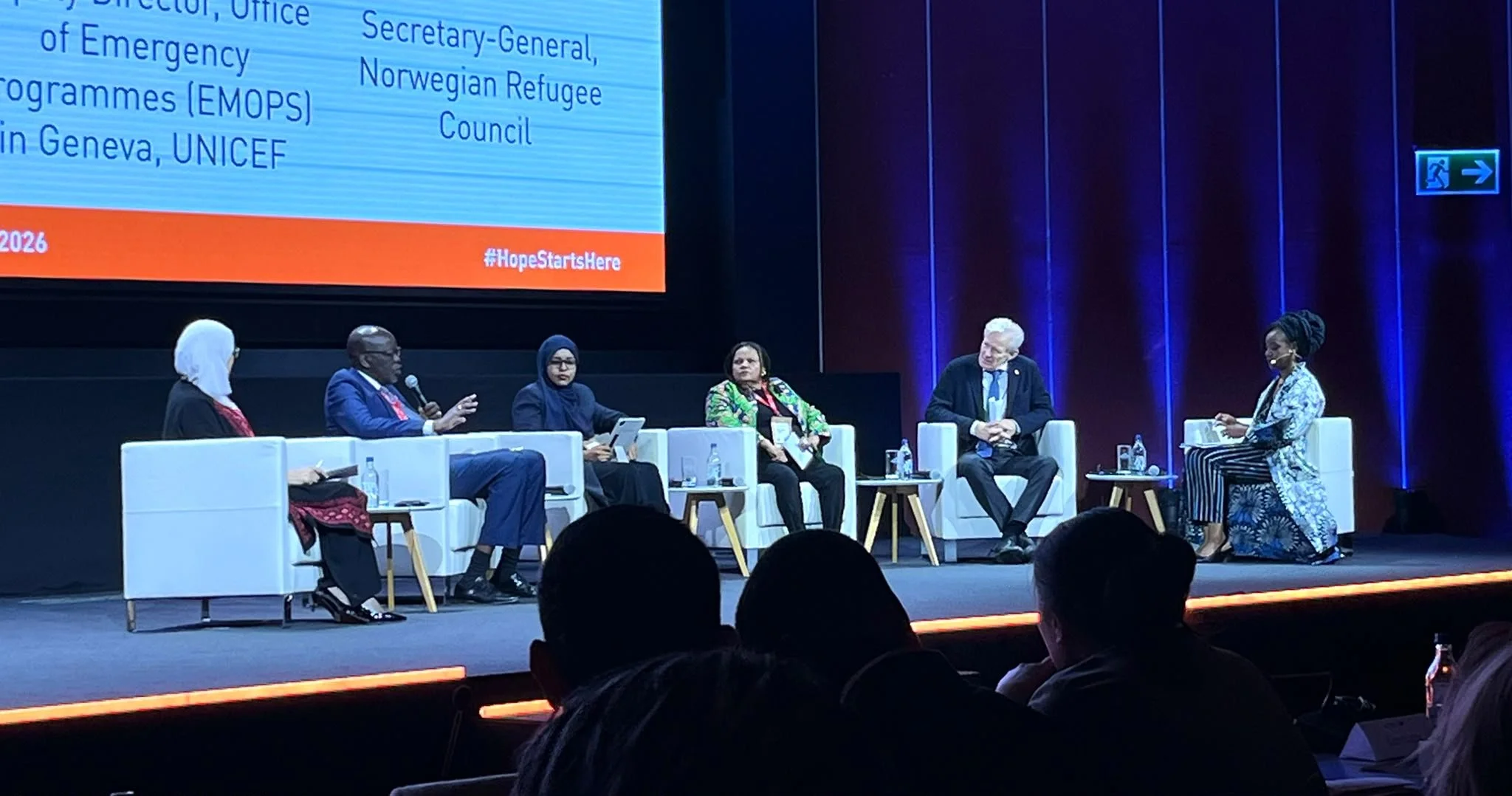
Dr Kuyok Abol Kuyok (second left) speaking on one of the ECW replenishment panels. (Image: IPNEd)
Dr Aliaa Assali, Acting Deputy Minister for the State of Palestine, explored the impact that the conflict and the fact that 92% of the state’s learning areas have been destroyed, has had on the lives of teachers, children and human rights.
“The right for education depends on the right for life, but both are being violated in Palestine,” Dr Assali said. “20,000 students, 2000 university students, and 800 teachers have been killed.”
“What is needed is dedicated resources, full salaries for teachers, and freedom of movement so students can reach their schools safely,” Dr Assali added.
“We must put the rights of Palestinian children first.”
Youth and teacher voices played a vital role in the high-level discussions, ensuring that children and teachers are both included in discussions and decisions surrounding education in emergencies.
IPNEd’s Executive Director, Joseph Nhan-O’Reilly, said “in a world where conflict and crises are at an all-time high and where 258 million children need educational support, the work of ECW and everyone working to advance children’s right to education is more important than ever.”
“This is a clear sign that the international community has not turned its back entirely on education, and that there is hope,” Mr Nhan-O’Reilly added.
“IPNEd looks forward to working with parliamentarians to encourage government action for ECW, so that no child living in crisis loses their right to an education.”
