

South Africa’s 2030 Reading Panel launches new literacy report
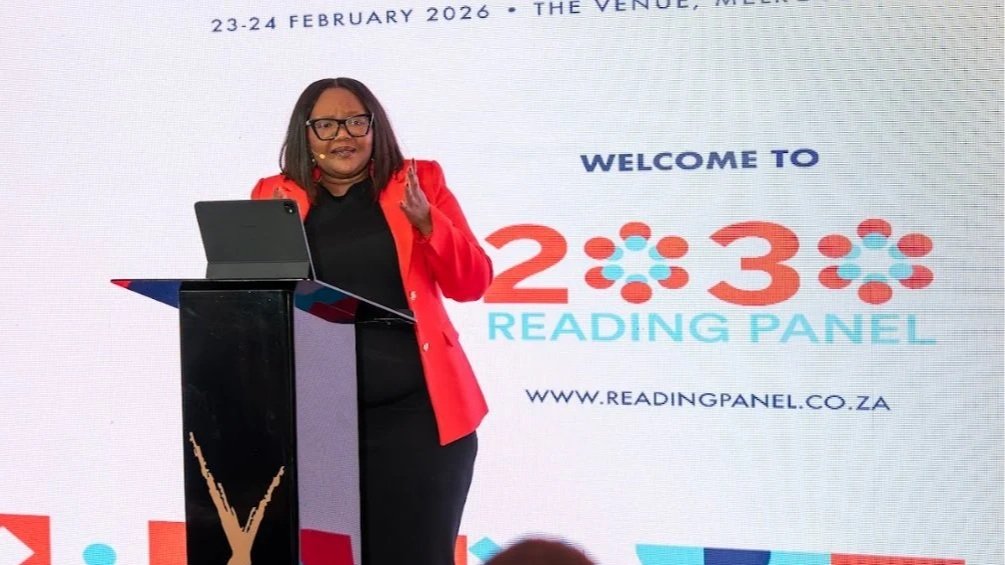
South Africa’s Minister of Basic Education, Siviwe Gwarube MP, delivers the keynote address at the 2030 Reading Panel Conference.
A new report launched by the 2030 Reading Panel shows that in South Africa, only 30% of Grade 1–3 learners are reading at grade level in their home language, with 15% of Grade 3 learners unable to read a single word.
The report was launched at the 2030 Reading Panel Conference in Johannesburg on 24 February, with a keynote address delivered by Minister of Basic Education, Siviwe Gwarube MP.
Political prioritisation of foundational learning, strong national coordination, and sustained funding are key to seeing progress on literacy. The 2030 Reading Panel in South Africa aims to do just that, working towards ensuring all children learn to read with meaning across the country.
A new report launched on 24 February at the 2030 Reading Panel Conference reveals the most up-to-date figures on learning. It shows that only 30% of learners aged 6-9 years old can read at grade level in their home language, and 15% of 8-9 year olds are unable to read a single word.
The report also found that literacy varies widely across different provinces, languages, and schools, demonstrating ongoing inequalities in learning.
Improving literacy outcomes in South Africa
The 2030 Reading Panel, convened by Dr Phumzile Mlambo-Ngcuka, the former Deputy President of South Africa, meets once a year to answer the question: “What needs to change for us to ensure that all children learn to read by 2030?”
Established in 2022, the Panel is an independent group of South African leaders from civil society, business, and former government officials working together to provide long-term, apolitical leadership to improve children’s literacy learning outcomes in the early years.
“The South African Reading Panel is a compelling example of how to create cross-sectoral awareness of the importance of reading at the same time as building support for action to ensure every child reads,” said Joseph Nhan-O’Reilly, the executive director of the International Parliamentary Network for Education.
Latest evidence reveals both progress and peril
The launch of the 2026 report on the latest learning in South Africa is informed by the government’s Funda Uphumelele National Survey (FUNS). This survey is the first nationally and provincially representative dataset of reading outcomes in Grades 1-4 in all languages based on government benchmarks.
Delivering the keynote address at the 2030 Reading Panel Conference, Minister of Basic Education, Ms. Siviwe Gwarube MP, said: "Let us ensure that reading is not just a privilege to a few children, but a birthright to every single child in every single home,".
Whilst the report showed promising progress in literacy across certain areas and demographics, it also revealed that children from the lowest socio-economic groups and in the lowest school quintiles are less likely to be learning at grade-level. This means equity is an alarming issue.
Minister Gwarube also outlined the Ministry’s reform plans, including expanded investment in Early Childhood Development, the scaling of system-wide literacy interventions, sustained teacher development and curriculum support, and implementing structured reading approaches in schools.
Read the 2026 Background Report from the Funda Uphumelele National Survey here.
