

5 years without school through an Afghan girl’s eyes: “I even miss the empty school building"
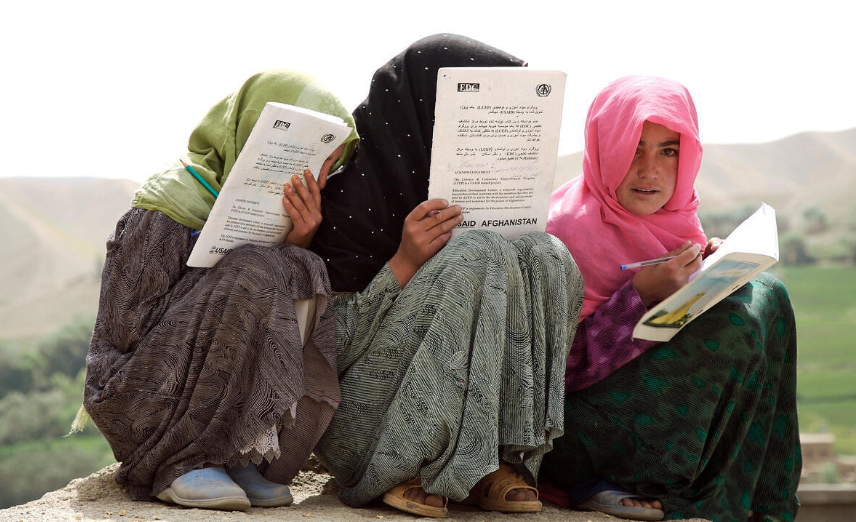
Girls studying for an exam in Afghanistan
5 years since the Taliban took power in Afghanistan, 2.4 million girls have been banned from continuing on to secondary education.
Aisha (not her real name), an Afghan student, says her dreams of helping others by becoming the first woman to study law in her province have all but disappeared.
Aisha has called on the world to not forget Afghan women and girls, and dreams of becoming a judge “to one day stand up against injustice like this.”
On 15 August 2021, millions of girls in Afghanistan lost the opportunity to continue their education. Aisha*, a student from a rural community in Afghanistan, shares what those five years have meant for her dreams, friendships and hopes for the future.
For many young people, school is a normal part of growing up. It is where children learn, make friends, discover what they enjoy and begin to imagine what they might do in the future.
For girls in Afghanistan, that future has been interrupted.
Girls have been banned from continuing their education beyond primary school since 2021. Afghanistan remains the only country in the world where girls and women are formally excluded from secondary and higher education. Around 2.4 million adolescent girls are currently unable to attend secondary school.
This has serious consequences for their future. Five years without school means five years without the chance to learn, prepare for a career and decide what the future might look like.
For Aisha, the impact has been deeply personal.
“All my dreams have disappeared.”
Before Aisha's education was interrupted, she had a clear ambition. She wanted to study law and become a judge, with the hope of becoming the first woman in her province to study law and use her education to help others.
Now, she says, that dream feels almost impossible.
“Not being able to go to school or university feels like dying little by little,” Aisha shares. “It is extremely difficult to go from dreaming about studying to thinking only about household responsibilities.”
She describes feeling that her future has been taken away, leaving her focused on managing everyday life rather than planning the life she once imagined.
Her experience reflects a much wider loss of opportunity. UNICEF and UNESCO have warned that millions of girls are missing out on secondary education, with long-term consequences for their futures and for Afghanistan's society.
When we think about school, we often think about lessons, homework and exams. But for Aisha, what she misses most are the everyday moments. She misses studying late into the night. She misses the healthy competition between friends as they try to achieve better marks. She misses walking with her friends.
And, perhaps most heartbreakingly, she says, “I even miss the empty school building.”
Most of all, Aisha says she misses her teachers and classmates.
Even now, when she unexpectedly sees one of her former teachers or classmates in a market or at a gathering, she says she struggles to hold back her tears.
Her memories show that education is about more than what happens inside a classroom. School is also a place where young people build friendships, develop confidence and begin to understand who they want to become.
Growing up without choices
Aisha lives in a rural community where girls already faced barriers to education before the current restrictions.
She describes seeing girls in her community leave education early and enter marriages at a young age. She says that today, only a small number of girls like her continue to hold onto dreams for their futures, but they have very little support to help them achieve those dreams.
For girls in remote communities, these challenges can make an already difficult situation even harder.
“I want to stand up against injustice.”
Despite everything that has happened, one part of her dream remains.
She says that after five years of thinking about why she wanted to study law, she now shares that, “I want to one day stand up against injustice like this.”
She still wants the opportunity to study. She still wants a future beyond the home. And she wants other girls to have that opportunity too.
Her message to people around the world is simple: “Please do not leave me, my sisters and Afghan girls alone in this situation.”
For decision-makers, MPs and education experts reading her story, this is also a call to action: five years on, Afghan girls must not be forgotten. We must continue to challenge the systematic denial of their right to education and recognise the wider system of gender apartheid in Afghanistan.
The global education community have a responsibility to keep Afghan girls’ education on the agenda, speak out against these restrictions, and stand with girls whose futures are being denied.
Education gives us knowledge, but it also gives us choices. It gives us friendships, confidence and the opportunity to discover what we are capable of.
For millions of girls in Afghanistan, that opportunity has been missing for five years.
Their dreams should not have to wait any longer.
*Aisha is a pseudonym to protect her identity
This article was written by Shuhra Koofi, Campaign Officer at Send My Friend to School, an education activist with experience working on girls’ education, gender equality and education advocacy, with a particular focus on Afghanistan.
