

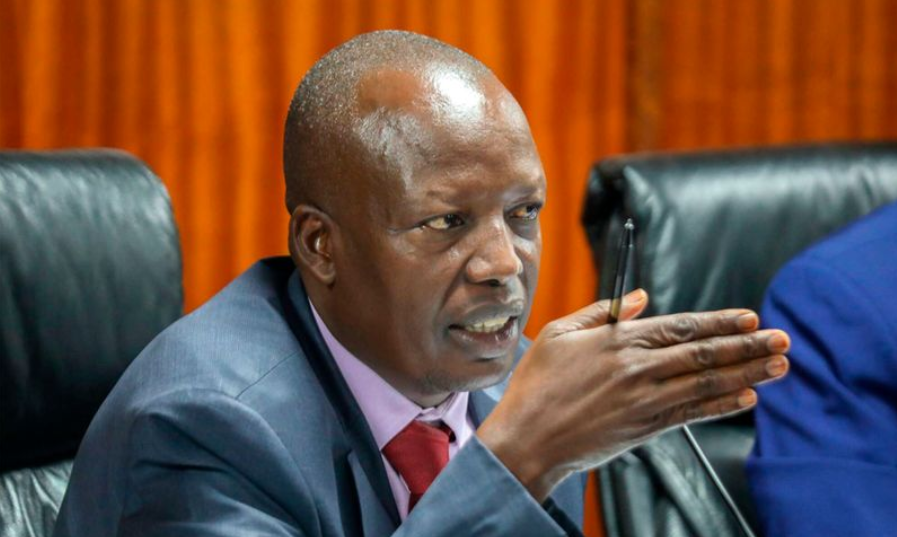
Chairperson of the National Assembly Committee on Education Julius Kibiwot Melly. (Dennis Onsongo | Nation Media Group)
A critical question that comes up in every budget cycle is: How much should Kenya spend on education? It is an important question, but it is only the beginning. The next question should be: Where do the resources go? Do the funds reach schools on time, and do they address the peculiar needs of Kenya's diverse communities? Importantly, do they ultimately improve learning?
These questions dominated discussions at a recent international meeting of MPs on education held in Nairobi under the auspices of the Global Partnerships for Education (GPE).
Our countries face different fiscal realities, but many of the questions confronting us are the same: how do we protect investment in education when budgets are under pressure? How do we ensure resources reach the learners and communities that need them most? And how do we know that the money we are spending is improving education?
For MPs, these are not simply technical questions for ministries of education and finance. Parliaments approve national budgets, scrutinise public expenditure and represent communities that experience firsthand the consequences of financing decisions. They also hold governments accountable for turning their commitments into results.
Kenya has consistently made education a major national priority. But large allocations alone do not guarantee that schools have the resources they need. Our experience with school capitation demonstrates this clearly.
There can be a significant difference between the capitation rate established for each learner, the amount provided for in the national budget, the resources subsequently released and the amount that eventually reaches schools for them to spend.
For a school, these differences have practical consequences. When funding falls short or arrives late, school leaders still have staff to pay, learning materials to purchase, facilities to maintain and children to teach.
This is why Parliament's responsibility cannot end when we approve the education budget. MPs must follow public resources to the learner, asking whether allocations are adequate, whether funds are released predictably and whether financing reflects the realities different schools face.
Schools do not operate under equal circumstances. A small school serving a remote community still needs teachers, classrooms, water and sanitation, learning materials and basic administration. It may also face greater challenges attracting teachers, maintaining infrastructure or reaching children living far from school.
Giving every learner the same allocation may appear equal, but that doesn’t necessarily make our financing equitable.
If we are serious about ensuring that every Kenyan child has the opportunity to learn, financing decisions must recognise where disadvantage is greatest and where additional resources can have the greatest impact.
Making these choices is increasingly difficult. Kenya, like many African countries, faces significant fiscal constraints and many competing demands on public resources.
That makes rigorous parliamentary scrutiny even more important.
MPs need to know which learners are being left behind and where existing expenditure is not producing the intended results.
Government has a responsibility to provide clear and timely information on how public resources are allocated and spent. Evidence from researchers, civil society organisations and the communities we represent can further strengthen that scrutiny.
We have recently seen the value of this wider engagement through the National Assembly's consideration of six education reform Bills. Through public participation and engagement with the Departmental Committee on Education, civil society and other education stakeholders have brought evidence and practical experience into Parliament as we consider reforms that will shape Kenya's education system.
The same principle should apply to education financing. For MPs, having better evidence must translate into stronger oversight of both equity and efficiency. Are the resources approved actually reaching schools, and on time? Are financing decisions addressing or reinforcing inequalities between communities? And can the government demonstrate that public spending is helping more children to learn?
Kenya cannot afford education spending that does not deliver. But neither can we afford a system in which a child's opportunity to receive a quality education depends on where they happen to live.
The discussion on education financing therefore cannot end with how much money we allocate. Parliament must scrutinise where it goes, whom it reaches and what it achieves.
This is where our budgetary, oversight and representative roles come together. MPs must ensure that Kenya’s investment in education is not only sufficient, but equitable, efficient and ultimately reaches the children it is intended to serve.
Hon. Abdul Haro MP is the Member of Parliament for Mandera South and a Member of the National Assembly’s Departmental Committee on Education. He is also a member of the International Parliamentary Network for Education.
This article was originally published in Daily Nation on the 11th of November, 2026.
