

“Parliaments must lead for learning,” says Harry Kamboni MP
Mr Kamboni is Chair of the Committee on Education, Science and Technology of the National Assembly of Zambia, and a member of the International Parliamentary Network for Education. Photo credit: ZANIS.
80 percent of government officials overestimate literacy proficiency in their countries and underestimate the extent to which this crisis could damage their countries' growth and development prospects.
Writing for the Global Education Monitoring (GEM) Report UNESCO, Zambian MP Harry Kamboni celebrated the start of an inquiry into foundational learning in Zambia, and called on parliamentarians everywhere to make foundational learning a political priority.
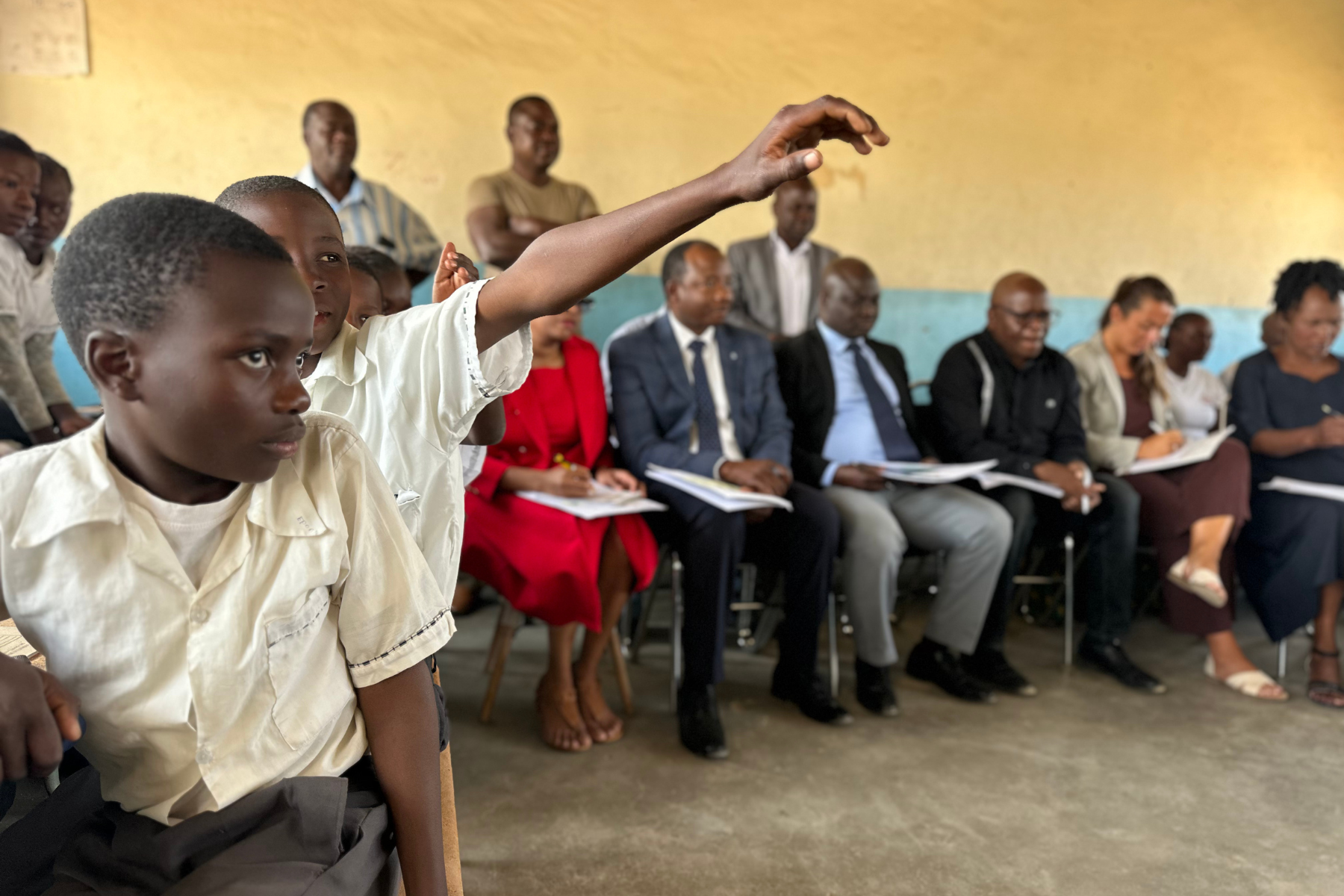
During a recent visit to a rural primary school in my constituency, I saw an 8-year-old student struggling to write the number four in his notebook. Watching from a distance, it was clear that he had difficulty holding his pencil and writing the correct form.
This is an all-too-common problem. In fact, the Global Education Monitoring Report’s ‘Spotlight on basic education completion and foundational learning in Zambia’, published in 2024, revealed the extent to which children do not acquire basic literacy and numeracy skills in the first three years of primary school.
Only 14% of Grade 4 students can perform basic math tasks, including recognising numbers and writing them down. The 2024 national assessment showed that just 12.7% of Grade 4 students can read and write at the expected level.
This isn’t just a problem in Zambia. In fact, across Africa, only one in every ten children acquires the reading skills we would expect by the end of year 3.
This has serious, immediate, and longer-term consequences for students, their communities, our country, and the continent.
The government of Zambia, led by President Hichilema, recognises this and has an ambitious plan to turn the situation around.
But this is a challenge which requires a sustained commitment at every level.
That’s why I am delighted that last year the Committee on Education, Science, and Technology of the National Assembly, which I chair, unanimously agreed to conduct an inquiry into foundational learning in Zambia. The first of its kind on the continent.
This week, we will begin to hear expert evidence, visit schools and speak to officials to help shape parliament’s response to the issue.
The fact that after three or more years of education, children haven’t acquired basic literacy and numeracy skills is a costly problem for governments.
Every Kwacha the government spends needs to be as effective as possible, and in education, the test must be whether it supports children to learn. It will be money well spent because having the skills to read, write, and count delivers multiple, real-world benefits.
To begin, they allow children to stay in school and learn higher-order skills, and go on to secondary and tertiary education.
They improve lifelong earnings, health outcomes, and civic engagement while also creating a more skilled workforce, reducing poverty and inequality.
Last year, President Hichilema was named the world’s first champion of foundational learning.
In taking on the role he said, “If we equip our children with solid foundational skills, they will not only thrive but also play a significant role in overcoming the many challenges the continent is experiencing, such as climate change, hunger and malnutrition, healthcare, and conflict.”
All children are born to learn. Learning the basics in primary school is a national imperative, outlined in our constitution, emphasised in our national development policy, articulated clearly in our new curriculum, and a personal priority of our Head of State.
However, without broader societal support, strong government commitment alone will not be enough, especially in the long term.
Turning around persistently low learning requires the efforts of educators, families, and community and political leaders.
If these groups are not aware of the scale of the problem and what must be done to solve it, education systems are likely simply to return to business as usual, with lifelong negative consequences for today’s students and their countries.
In a recent survey, 80 percent of government officials overestimated literacy proficiency in their countries and underestimated the extent to which this crisis could damage their countries' growth and development prospects.
We urgently need to ensure everyone understands the extent of this challenge, its significance, and how to solve it.
The Zambian parliament’s inquiry into the state of foundational learning in Zambia will be crucial to developing a shared understanding of the problem and ensuring cross-party support for a national effort to improve learning outcomes.
We will begin our investigation this week, engaging with stakeholders, reviewing learning levels firsthand, and building our own understanding of the barriers and solutions to improved learning.
We will explore what more can be done to prepare and support teachers to teach reading and math more effectively, guarantee that children have the books needed to learn, and ensure that all children have access to the government’s evidence-based remedial programme, Catch-Up.
Catch-Up is an important programme, as it helps students in Grades 3, 4, and 5 who have fallen behind in mainstream literacy and numeracy classes to catch up to the right level.
After we introduced the free education policy in 2022, more than 2 million students returned to the classroom. Many were behind for their age, and some hadn’t been in school for years. Catch-Up helps to remedy that situation and helps children to literally catch up.
However, strengthening the education system as a whole, thereby eliminating the need for remedial lessons and catch-up classes, must be our ultimate goal.
Disparities in access and resources between urban and rural schools and classrooms are another challenge. Whatever we do must help close the gap between rural and urban learners.
I’m excited to use the inquiry to strengthen cross-party commitment to ensuring that every child in Zambia, whether in a town or the country, is in school and learning.
I’m confident that our work can serve as a model for other African parliaments and help legislators understand the problem and agree on evidence-based solutions.
For the young boy I saw struggling to write the number four, and for all the children like him who are unable to read or write at their grade level, our commitment must be to help them become literate and numerate.
Parliamentarians, as individuals, and parliaments, as institutions, are critical to this effort. We must represent the interests of children, pass laws that guarantee they are in school and learning, ensure that the education system is adequately funded, and hold our governments to account.
I call upon my parliamentary peers worldwide to make foundational learning a political priority for every child, everywhere. I look forward to sharing the experience of our inquiry with colleagues and growing political support for a world in which all children are in school and learning.
Honourable Harry Kamboni MP is Chair of the Committee on Education, Science, and Technology of the National Assembly of Zambia, and a member of the International Parliamentary Network for Education.
This article was originally published by the GEM Report UNESCO on 14th January 2026.
