

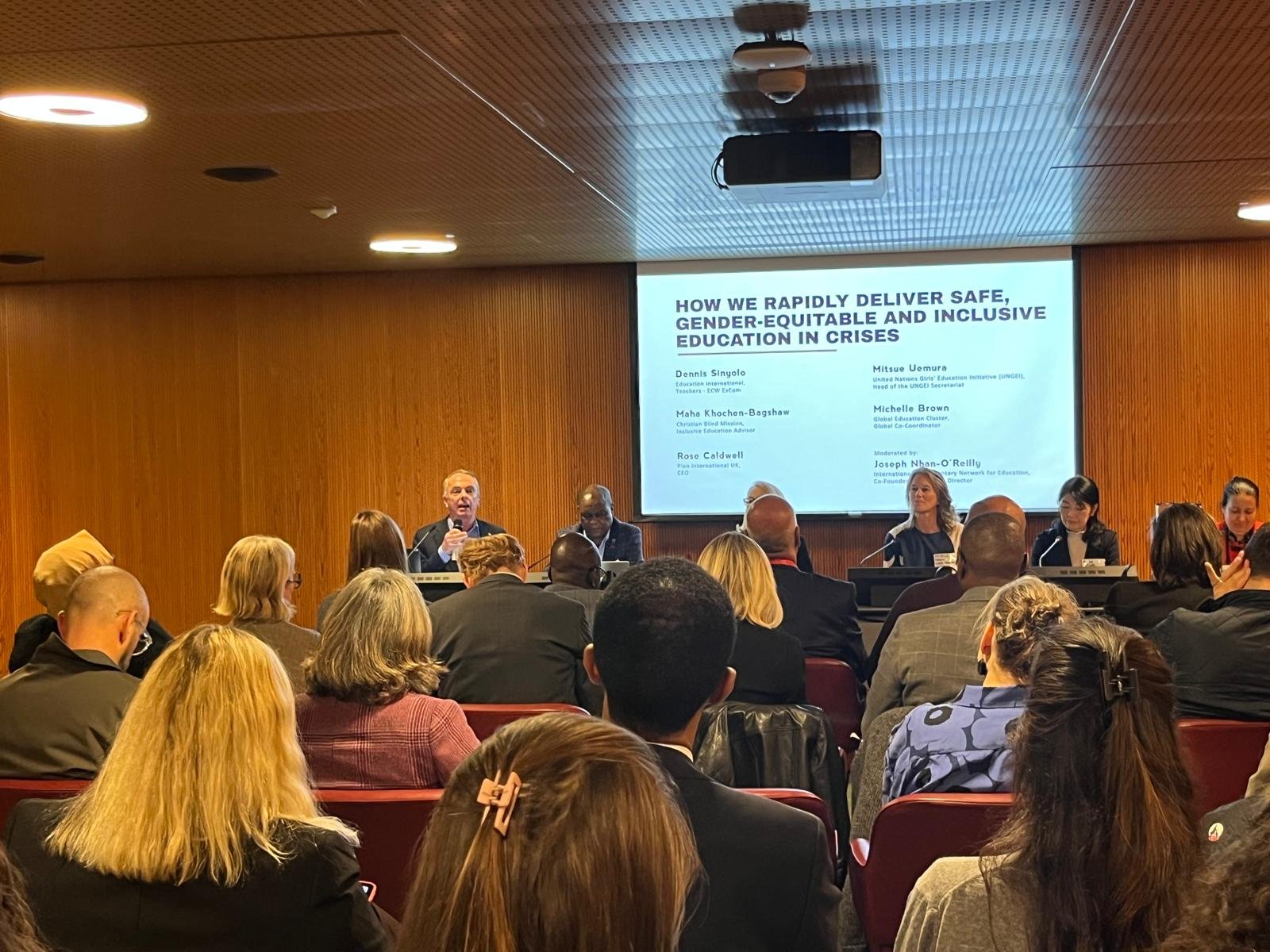
Attendees of the high-level replenishment event for Education Cannot Wait celebrated the total pledge of $541.1m USD to support education in emergencies. (Image: IPNEd)
Civil society organisations (CSOs) met ahead of the high-level replenishment of Education Cannot Wait (ECW) to discuss how international partners can strengthen collective responses to education in emergencies.
Representatives of donor countries also discussed their nations’ commitment to delivering meaningful and sustainable financial aid.
Discussions centred around three key areas: shifting power to local actors, delivering inclusive education in emergencies, and securing sustainable financing.
Shifting power and resources to local and national actors
The first panel explored the importance of ensuring local and national actors in crisis-affected countries have influence over discussions and decision-making processes on education initiatives.
CSOs and MPs on the panel stressed that children, teachers and affected communities must play a meaningful role in shaping contextually appropriate and effective education responses in emergency situations, therefore building more resilient education systems.
“The important thing is whether the response leaves behind a stronger education system than existed before the crisis,” said Dr Kuyok Abol Kuyok, Minister of General Education and Instruction for South Sudan.
Delivering inclusive education in emergencies
The second panel, led by IPNEd’s Executive Director Joseph Nhan-O'Reilly, focused on the disproportionate impact of crises on girls, children without disabilities, and those without caregivers.
Panelists stressed that the needs of the most disadvantaged children must be central to education in emergency situations.
The panel also made the case for investment in teacher training, support, and salaries.
Sustainable and equitable financing for education in emergencies
Declining external financing, rising debts and competing budget priorities are putting significant constraints on education financing around the world.
The third and final panel discussed the importance of longer-term investment alongside short-term support, and how international partners can make better use of limited resources.
Speakers called for flexible, predictable financing that allows countries to respond to and recover from crises without interrupting children’s right to education.
ECW Director Maysa Jalbout closed by calling for collective action to reach children most affected by crises. “Education must be the base for the response to a crisis, not something that waits until other needs are met,” Ms. Jalbout said.
