

In the Philippines, technology-facilitated violence is depriving girls of an education
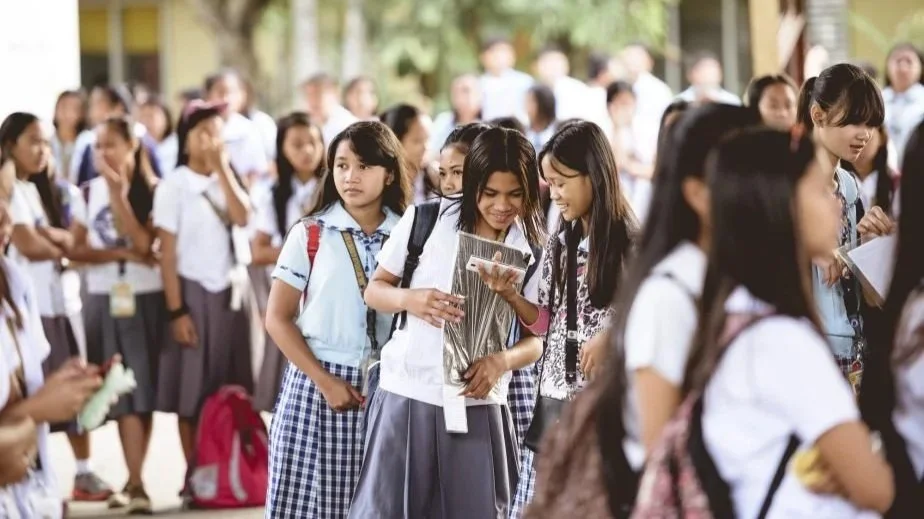
A group of Filipino high school students at a school in Bacolod, Philippines, March 1, 2019. Credit: Depositphotos via The Diplomat.
Access to education means little if girls are denied protection from harassment, cyber-bullying, and online sexual exploitation
The right to education does not end at the classroom. It extends into digital spaces, including social media, group chats, messaging apps, and even online learning platforms. When those spaces become sites for harassment, cyber-bullying, sexual exploitation, blackmail, or humiliation, students—especially girls—are denied this right.
Imagine you are a teenage girl at school, walking into the classroom and seeing your peers laughing into their screens. Then comes the shock of discovering that they are laughing at photos of you that have been digitally altered into explicit content and shared across social media.
While this is a shocking example of digital abuse, it is also a frightening reality for millions of women and girls navigating the digital world today.
Technology-facilitated violence against women and girls may stop girls from participating in the classroom or cause them to avoid school altogether. It may sap them of confidence, concentration, and trust. They may be physically present in class, but emotionally pushed out of learning.
Access to education means little if girls are denied the safety required to benefit from it equally.
Girls are disproportionately affected by online violence because digital platforms amplify real-world inequalities and structural power imbalances that perpetuate misogyny.
Globally, 300 million children were affected by online child sexual exploitation and abuse in 2024. In my country, the Philippines, UNICEF reports that more than 2 million children were subjected to online sexual abuse and exploitation in 2021 alone.
This demands urgent action.
The rapid advancement of the digital environment too often outpaces the much slower, deliberate legislative process. This makes it difficult, but far from impossible, to create new laws that make technology-facilitated violence against girls a crime and a punishable offense.
As a member of the House of Representatives of the Philippines, I pushed to amend the Anti-Violence Against Women and Their Children Act last year. The amendment seeks to reflect the reality that abuse is no longer limited to physical spaces and set out clear penalties for perpetrators.
It makes clear that abuse now also happens through smartphones, social media, messaging platforms, and other digital tools. It outlines the types of abuse that would fall under this, from recording and sharing intimate or sexualized images or videos to online harassment, intimidation, coercion, or threats. However, it is certainly not limited to these only.
The bill recognizes that technology-facilitated violence against women and girls can spread at scale and can leave deep emotional and social harm. For girls in school, that legal recognition matters.
It defines the abuse and makes it punishable. It sends a message that cyber-harassment, stalking, fake accounts, humiliation and other forms of technology-facilitated abuse will be treated with seriousness by institutions, families, and authorities.
This proposed measure will complement the Safe Spaces Act, which already prohibits gender-based sexual harassment in schools, online, and public spaces. However, effective enforcement and sufficient budgetary allocation remain critically lacking. The state holds the primary duty to address these gaps and the education system must support their implementation to ensure girls are safe in schools.
Technology-facilitated violence against girls must be treated as a serious safeguarding and learning issue in schools.
UNICEF has stressed that child protection mechanisms and safeguarding policies must operate in all settings where children access the digital environment, including schools, and that digital learning systems need clear reporting and referral pathways.
Institutions must prevent abuse, respond in survivor-centred ways, and ensure that digital spaces and schools do not reproduce gender inequality.
Evidence from UNESCO shows that schools need trained teachers, confidential reporting mechanisms, psychosocial support, clear online protection guidelines, and partnerships with child-protection and justice services so that girls are not left to navigate abuse alone.
Without that support, the promise of legal reform remains incomplete, and the right to education cannot be fully realized.
In this digital age, the right to education includes the right to learn without fear—both online and offline.
If girls are harassed into silence, blackmailed out of school, or driven away from digital spaces, then education systems are failing not only to include them, but to protect the conditions under which learning is possible.
Marking the month of March for International Women’s Day, with this year’s theme of rights, justice, and action, I call upon my fellow political leaders to act with urgency to stop technology-facilitated violence against women and girls.
Girls in the Philippines—and beyond—should not have to choose between their safety and their education. It is our responsibility to guarantee both.
Sarah Elago is a Member of the House of Representatives of the Philippines and a member of the International Parliamentary Network for Education.
This article was originally published in The Diplomat on the 31st of March, 2026.
