

IPNEd opens education session at SADC Parliamentary Forum
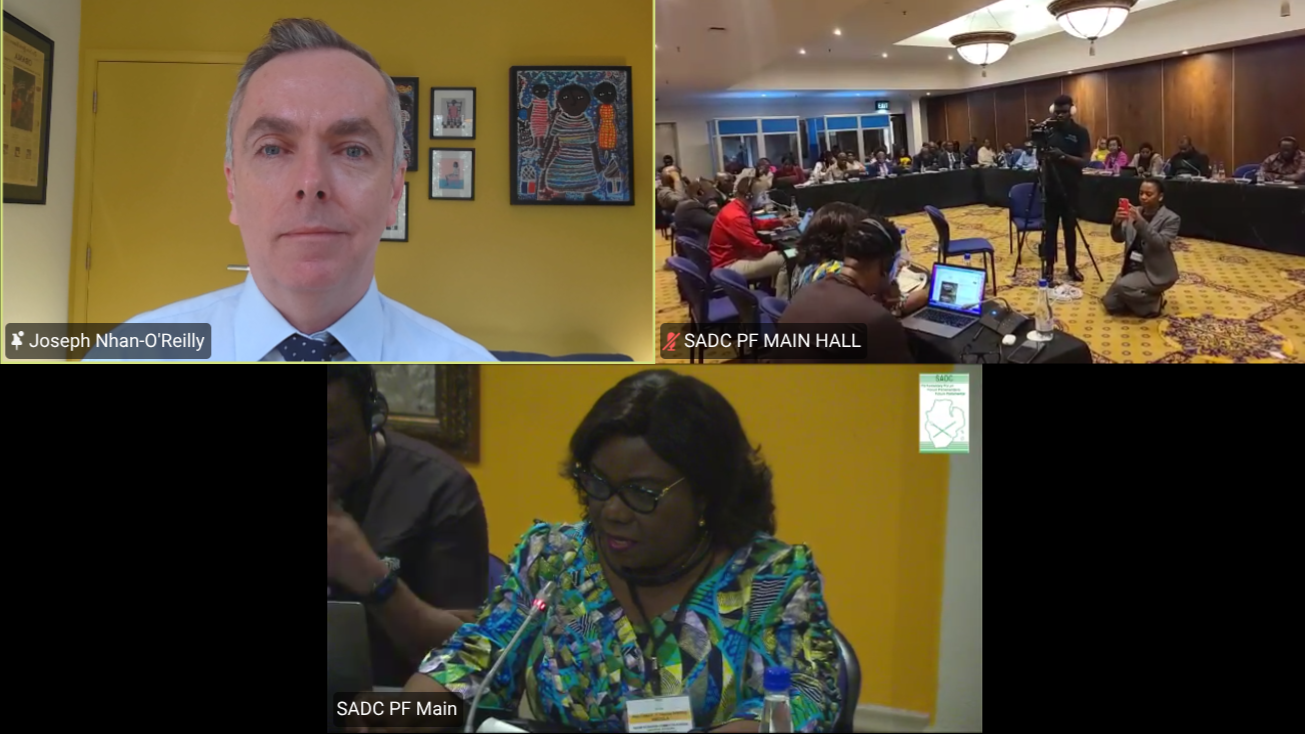
IPNEd’s Executive Director, Joseph Nhan-O’Reilly, gave a presentation on foundational learning to open the education session of the meeting.
IPNEd’s Executive Director addressed MPs during a meeting of the Southern African Development Community (SADC) Parliamentary Forum’s Standing Committee on Human and Social Development.
The meeting discussed the centrality of foundational literacy and numeracy as a driver of human capital development.
The path to human capital starts with foundational learning.
That was the message of IPNEd’s opening presentation at the education session of the Southern African Development Community Parliamentary Forum (SADC PF).
The meeting was attended by over 30 Members of Parliament from 16 member states, representing more than 400 million citizens. There were also several national education coalitions present, including the Zimbabwe Network of Early Childhood Development Actors (ZINECDA) and the Zambia National Education Coalition (ZANEC).
Foundational learning is the key to greater human capital
IPNEd’s Executive Director, Joseph Nhan-O’Reilly, opened the second day of the conference with a presentation on the importance of foundational learning.
He reminded MPs that quality basic education makes children more likely to stay in school, continue on to higher education, and become productive citizens who earn more than those without foundational skills.
“We know that if children acquired foundational skills, your economies would grow, taxes would rise, children would complete primary and proceed to secondary. Fewer girls would be married earlier, child mortality would fall,” he said.
Mr Nhan-O’Reilly made the case that member states can act to improve foundational learning now, without needing to solve all the challenges of education infrastructure at once. MPs should focus on ensuring teachers have the latest knowledge and skills to teach effectively, in a language that children already understand.
He called on MPs to take several key actions, including making a national commitment to ensure all children become skilled readers.
He also shared an opportunity to use legislation to improve learning outcomes.
Referring to the Right to Read campaign in South Africa, he shared their work to make early-grade literacy a national priority through legislative reform and the development of binding regulations for the first three grades.
“Lawmakers have the opportunity to use regulations to clarify the state’s obligations in respect of things that we know influence learning outcomes,” said Mr Nhan-O’Reilly.
“By mandating teaching time, teacher training, quality learner and teacher support materials, and regular literacy testing and an appropriate testing regime, parliaments can help ensure that these things are done and thereby help ensure that children with access to school actually acquire the skills we know they must.”
The presentation was met with enthusiasm from MPs, who recognised the importance of foundational learning amid the multiple challenges that many education systems face.
“It is clear that there has to be an intentional approach to achieving the educational outcomes of our children,” said Senator Dr Linda Nxumalo, representing Eswatini at the conference.
IPNEd looks forward to continued engagement with the SADC Parliamentary Forum, where the network will also present on education to the Women’s Caucus in May.
